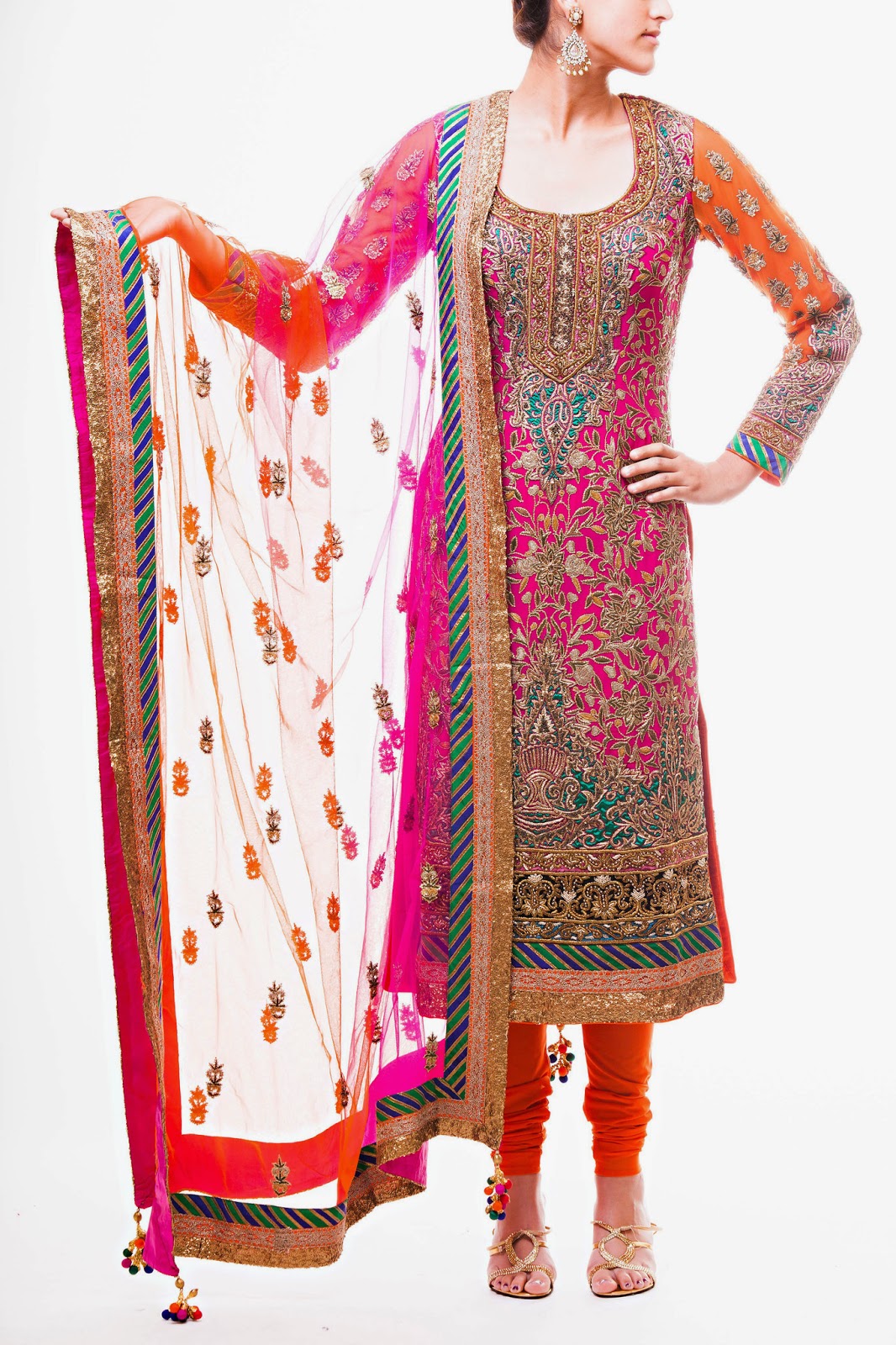
Churidars (Hindi: चुडीदार)(Urdu: چُوڑی دار), (Punjabi: ਚੂੜੀਦਾਰ), or more properly churidar pyjamas (ਚੂੜੀਦਾਰ ਪਜਾਮਾ), are tightly fitting trousers worn by both men and women in South Asia. Churidars are a variant of the common salwar pants. Salwars are cut wide at the top and narrow at the ankle. Churidars narrow more quickly, so that contours of the leg are revealed. They are usually cut on the bias, making them naturally stretchy. Stretch is important when pants are closefitting. They are also longer than the leg and sometimes finish with a tightly fitting buttoned cuff at the ankle. The excess length falls into folds and appears like a set of bangles resting on the ankle (hence 'churidar' 'churi': bangle, 'dar': like). When the wearer is sitting, the extra material is the "ease" that makes it possible to bend the legs and sit comfortably. The word churidar is from Hindi and made its way into English only in the 20th century. Earlier, tight fitting churidar-like pants worn in India were referred to by the British as Moghul breeches, long-drawers, or mosquito drawers.
Thursday, 15 October 2015
bridel lehnga
bridel lehnga
In India, the wedding rituals and clothes make the wedding as much as that of the bride and her groom. Both look their splendid best in gorgeous clothes. Not just the couple, but the guests attending the family and the relatives are often seen dressed up to the teeth. The bride is dressed up in auspicious colors, whereas the bridegroom is dressed to exude a regale aura. The brides maid and best men are often dressed in par with the bride and the groom. But they are toned down a bit because the day belongs to the couple. All the folks attending the marriage are decked up with gold jewelry including the bride and sometimes the groom. The ladies are additionally adorned with henna patterns all over their palms, hands, forearms, legs and feet. Sometimes henna patterns are replaced with alta designs which are short lived and easily removable.
Indian weddings generally tend to continue for several days and new attire is worn each day. All these dresses and the color symbolize the meaning of marriage and the period that follows it. Indian wedding is one that gives more importance to details like different rituals and the various attires one wears to attend them.
Indian hindu wedding continue for several days. India is a country that defines diversity and this is visible even in the wedding and its different styles. The ceremonies, the rituals, the formalities are all different between each region and culture. Unlike the Christians, Hindus wedding ceremony does not resemble the western marriages and are quite elaborate. In the North,Starting from the tilak ceremony, each function has significance in the marriage. Tilak, sangeet, haldi, bharat and the shaddi all necessitate the Bride and the bridegroom to wear new attire at each occasion.All these above ceremonies are known by different names in the other parts.
ANEEZ CREATIONS
7589089000
Monday, 21 September 2015
Lehnga
Lehenga or lehnga or Ghagra or Pavadai in Tamil or Langa in Telugu and Kannada is a form of skirt which is long, embroidered and pleated. It is worn as the bottom portion of a gagra choli or langa voni. It is secured at the waist and leaves the lower back and midriff bare In North India a lot of embroidery work is done on a lehenga and is popular during the festivals and weddings.The ancient version of skirt or Ghagri evolved from Bhairnivasani, which in turn evolved from the Antariya when stitched on one side became tabular and was worn gathered together at the waist, and held by a girdle. This was one of the earliest forms of a stitched skirt. It was worn using drawstring or nada.The ghagri was a narrow skirt six feet long the same length as original antariya. This style can still be seen worn by jain nuns in india.
ANEEZ CREATIONS
ANEEZ CREATIONS
7589089000
bridel lehnga
bridel lehnga
In India, the wedding rituals and clothes make the wedding as much as that of the bride and her groom. Both look their splendid best in gorgeous clothes. Not just the couple, but the guests attending the family and the relatives are often seen dressed up to the teeth. The bride is dressed up in auspicious colors, whereas the bridegroom is dressed to exude a regale aura. The brides maid and best men are often dressed in par with the bride and the groom. But they are toned down a bit because the day belongs to the couple. All the folks attending the marriage are decked up with gold jewelry including the bride and sometimes the groom. The ladies are additionally adorned with henna patterns all over their palms, hands, forearms, legs and feet. Sometimes henna patterns are replaced with alta designs which are short lived and easily removable.
Indian weddings generally tend to continue for several days and new attire is worn each day. All these dresses and the color symbolize the meaning of marriage and the period that follows it. Indian wedding is one that gives more importance to details like different rituals and the various attires one wears to attend them.
Indian hindu wedding continue for several days. India is a country that defines diversity and this is visible even in the wedding and its different styles. The ceremonies, the rituals, the formalities are all different between each region and culture. Unlike the Christians, Hindus wedding ceremony does not resemble the western marriages and are quite elaborate. In the North,Starting from the tilak ceremony, each function has significance in the marriage. Tilak, sangeet, haldi, bharat and the shaddi all necessitate the Bride and the bridegroom to wear new attire at each occasion.All these above ceremonies are known by different names in the other parts.
ANEEZ CREATIONS
7589089000
PAJAMI SUIT
Churidars (Hindi: चुडीदार)(Urdu: چُوڑی دار), (Punjabi: ਚੂੜੀਦਾਰ), or more properly churidar pyjamas (ਚੂੜੀਦਾਰ ਪਜਾਮਾ), are tightly fitting trousers worn by both men and women in South Asia. Churidars are a variant of the common salwar pants. Salwars are cut wide at the top and narrow at the ankle. Churidars narrow more quickly, so that contours of the leg are revealed. They are usually cut on the bias, making them naturally stretchy. Stretch is important when pants are closefitting. They are also longer than the leg and sometimes finish with a tightly fitting buttoned cuff at the ankle. The excess length falls into folds and appears like a set of bangles resting on the ankle (hence 'churidar' 'churi': bangle, 'dar': like). When the wearer is sitting, the extra material is the "ease" that makes it possible to bend the legs and sit comfortably. The word churidar is from Hindi and made its way into English only in the 20th century. Earlier, tight fitting churidar-like pants worn in India were referred to by the British as Moghul breeches, long-drawers, or mosquito drawers.
Subscribe to:
Posts (Atom)